
Every Art School
Promises Creativity.
Here's What You Should
Actually Compare.
Curriculum hours. Faculty-to-student ratios. Portfolio review frequency. Graduate outcomes. We put it all in one place — because a good art education deserves honest evaluation criteria.
What to Actually Ask Before You Enroll Anywhere.
Most art schools make you schedule a tour to get this information. We put it in a table. Use it to evaluate us — and everyone else.
| Evaluation Criteria | Community Class Weekend hobbyist | Online Course Self-directed | Art University BFA program | Art Bootcamp Intensive | Syllabus ← That's us |
|---|---|---|---|---|---|
Studio Hours / Week Scheduled hands-on studio time per week | 2–3 hrs | Self-paced | 12–16 hrs | 8–10 hrs | 18 hrs |
Faculty-to-Student Ratio How many students share each instructor | 1 : 20+ | 1 : 500+ | 1 : 16 | 1 : 12 | 1 : 8 |
Portfolio Reviews Formal critique sessions per semester | 0–1 | 0 | 2 | 3–4 | 6 |
Foundational Drawing Dedicated figure drawing & observational curriculum | Partial | Modules only | Yes | Limited | Full year |
Working Artist Faculty Instructors with active professional practices | Varies | Rarely | Some | Mixed | 100% |
Graduate Portfolio Placement % of grads accepted to BFA/MFA programs or employed | Not tracked | Not tracked | Varies widely | ~40–60% | 94% |
Materials Cost (Annual) Estimated out-of-pocket materials per year | $200–$600 | $0–$100 | $1,800–$3,200 | $600–$1,000 | $480–$720 |
Critique Culture Structure of feedback — formal vs. informal | Informal | Peer/async | Formal | Structured | Professional standard |
Enrollment Flexibility Can you join mid-year or part-time? | Yes | Yes | No | Limited | Evening + weekend tracks |
* Data based on publicly available program information and Syllabus internal records, 2024–25. Art university figures represent national averages across accredited BFA programs.
The Art School Comparison Guide
A 12-page evaluation framework we give away free — because students who understand what to look for make better decisions, whether they choose us or not.
- 15 questions to ask any art school admissions office
- How to read a curriculum for actual studio time
- What 'portfolio review' really means — and how to tell good from bad
- The 3 graduate outcome metrics that actually predict career success
Get the guide
No spam. One email with the PDF. That's it.
What Week One Actually Looks Like.
No vague promises about “creative exploration.” This is the actual 16-week schedule for Foundation Year students. Click any module to see what happens inside the studio.
Observational Drawing Fundamentals
- Contour line, gesture, and proportion from live model
- Charcoal, graphite, and compressed charcoal introduction
- Sketchbook practice: 30 drawings minimum
The 50-Minute Critique Format We Use Every Time.
Silent Viewing
The room looks at the work in silence. No context from the artist. First impressions only.
Descriptive Response
Peers describe what they see — not what they like. Objective visual language only.
Interpretive Discussion
What is the work doing? What problems is it solving? What questions does it raise?
Artist Responds
The artist speaks last. Context, intention, what surprised them. No defending, only expanding.
Faculty Synthesis
The instructor identifies the central tension in the work and assigns targeted exercises.
Real Names. Real Placements.
No Averages.
We track every graduate. Not because we have to — because our faculty want to know if what they're teaching translates to careers.

“I came in not knowing how to hold a brush properly. Syllabus gave me 18 months of structure I couldn't have built on my own.”

“I was a financial analyst. Three years of Syllabus evenings later, I have a portfolio that got me hired at the firm I'd been looking at for a decade.”
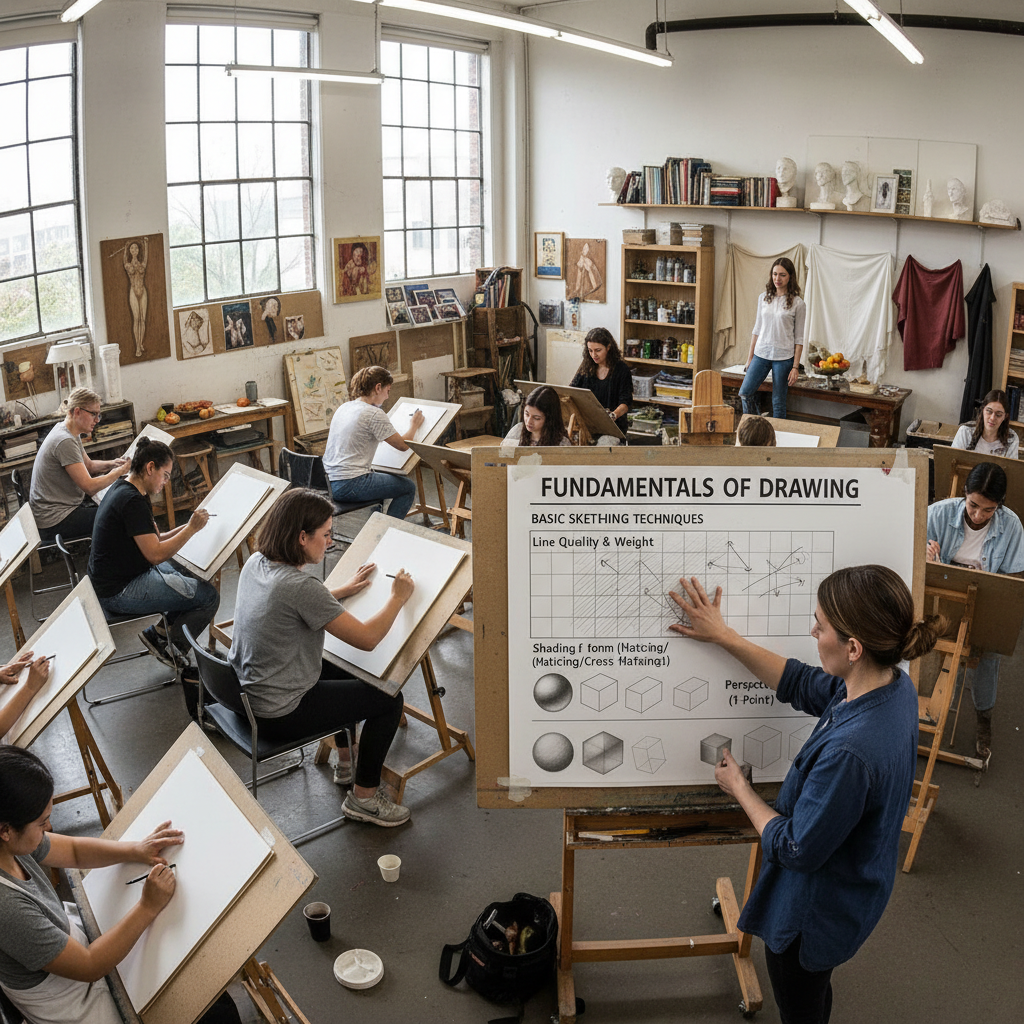
“My SAIC portfolio reviewer specifically mentioned the quality of my observational drawings. That's pure Syllabus curriculum.”
“I'd been drawing since I was a kid but never had formal training. The gap showed. Syllabus closed it.”
The Art School Comparison Guide
A 12-page evaluation framework we give away free — because students who understand what to look for make better decisions, whether they choose us or not.
- 15 questions to ask any art school admissions office
- How to read a curriculum for actual studio time
- What 'portfolio review' really means — and how to tell good from bad
- The 3 graduate outcome metrics that actually predict career success
Get the guide
No spam. One email with the PDF. That's it.